
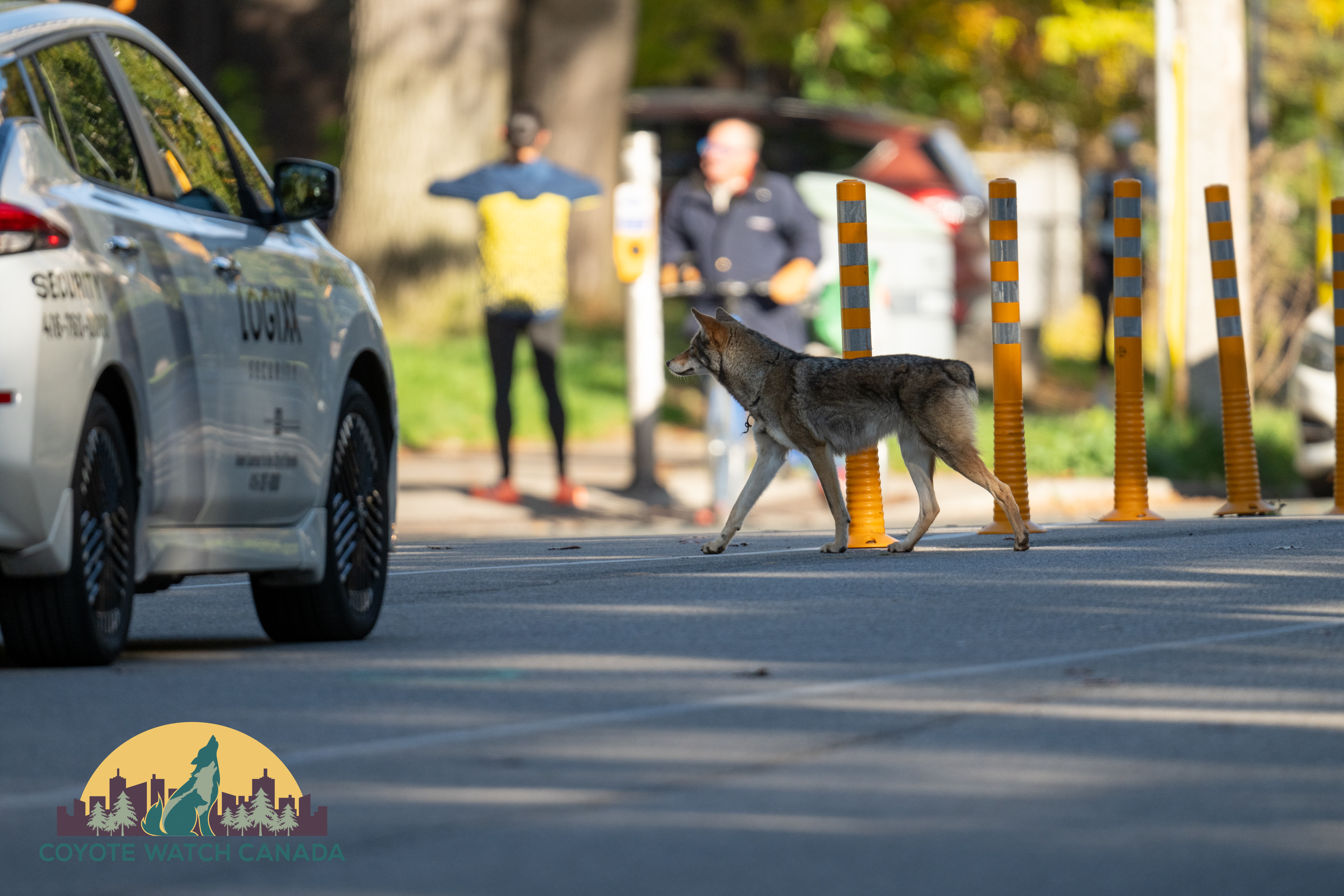
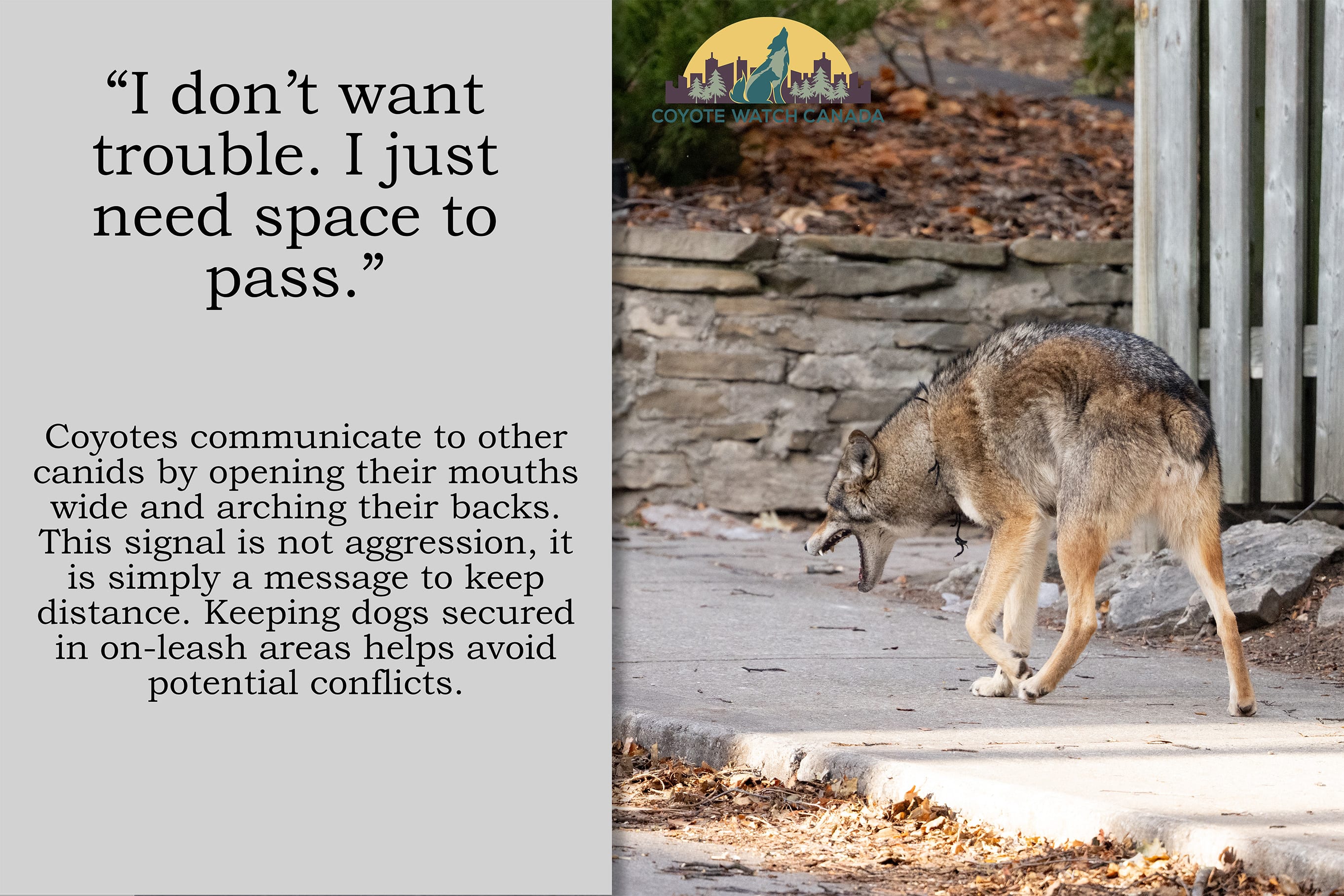
Coyotes are remarkably expressive. We simply need to learn how to understand what they are communicating. Coyotes often signal “keep your distance,” not to threaten, but to create space and avoid conflict. Their wide-open gape is frequently mistaken for a yawn or aggression by those unfamiliar with canid communication. In reality, a coyote’s large mouth gape, often paired with an arched back, is a clear message to other canids including dogs and other coyotes that they want space, peace, and a trouble-free path forward.
Bunny, the well-known Toronto-based Eastern Coyote, is a good example of this restraint. Often spotted during daylight, she is sometimes mistaken for an off-leash dog. The netting around her neck has even been confused by some for a collar. Despite frequent contact with people and dogs throughout her daily travels, she typically moves through the city with little more than a glance in passing.
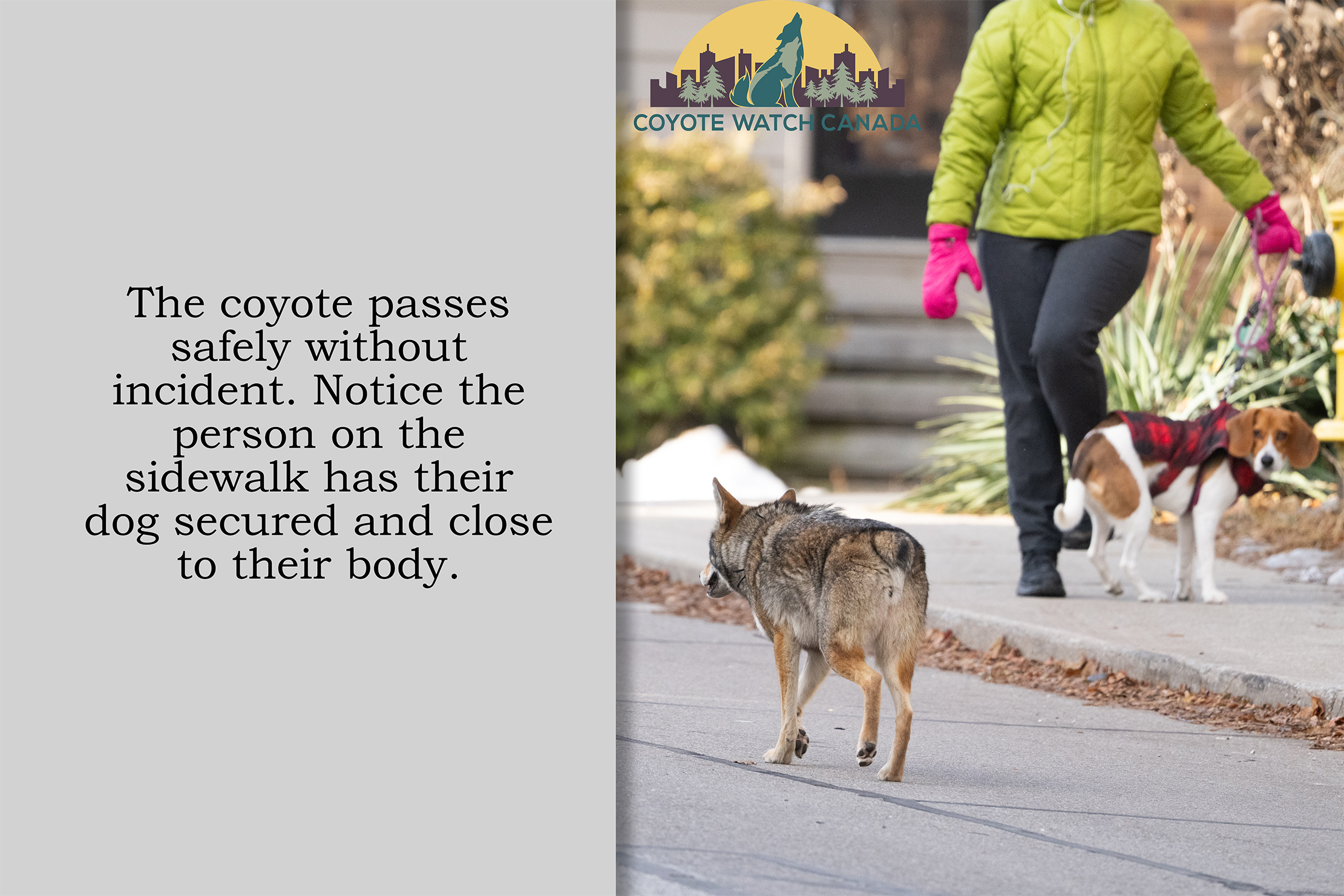
During a five-minute window one day in December, Bunny encountered two leashed dogs on a residential sidewalk. Each time, she opened her mouth wide and arched her back. In coyotes with tails, this posture creates a more visible curve, but because Bunny has no tail, the arc is less pronounced. Both dogs were leashed and she passed without issue. The outcome could have been different if the dogs were unsecured and ignored her signals only to approach her. In fact our Canid Response Team and citizens have witnessed Bunny being chased by dogs on multiple occassions. While coyotes may run when chased by dogs, this response is not harmless. Being pursued triggers intense stress and fear, which can lead to what animal specialists call "trigger stacking", essentially a buildup of stressors that makes an animal increasingly reactive over time.
When coyotes are repeatedly chased or harassed, they may begin to associate the presence of dogs whether leashed or off-leash, with danger. This can increase defensive or reactive behaviour, raising the risk of future conflict. Forcing wild animals to flee also depletes vital energy they rely on for hunting, caring for young, and surviving seasonal challenges. Energy lost to unnecessary stress cannot easily be replaced.
Responsible pet guardianship means preventing dogs from chasing wildlife. Keeping dogs leashed and under control protects coyotes, pets, and the broader community and supports peaceful coexistence with the wildlife that share our landscapes.
This is why maintaining control over dogs in on-leash areas is so critical. It is a responsibility shared by all pet guardians.
There have been reports of unsafe human behaviour around Bunny. Some have attempted to hand-feed her to draw her closer. Others have allowed children to approach her. One person attempted to block her from catching a squirrel to “save the squirrel.” If a coyote bites someone, regardless of context or cause, the result is often lethal removal. Interference, feeding, or close contact can put her life in danger.
Bunny does not need rescuing, supervising, or supplemental feeding. She is highly capable of finding and catching her own food (skilled in foraging and hunting). What she does need is space, respect, and safe distance. Daylight sightings are not an invitation for interaction. Peaceful passage depends on respecting boundaries and correctly interpreting communication, especially with wild neighbours who are navigating a human-built world.
Important Message: Bunny currently has sports netting around her neck. At this time, she is not showing any signs of injury or distress. She is moving freely through her extensive territory, hunting successfully, and behaving as a healthy, resilient coyote.
Bunny lives a transient life across the landscape, which means her range is wide and constantly changing. While seeing netting on a wild animal can understandably be concerning, attempting to capture her to remove it at this point would be extremely difficult and would likely cause significant stress and risk to her well-being. Both the Toronto Wildlife Centre and Coyote Watch Canada are aware of Bunny’s situation and are actively and thoughtfully monitoring her condition. Toronto Animal Services is also cognizant of her current status and advise citizens with similar reminders such as keep a respectful distance, leash dogs and do not approach or attempt to feed this coyote.
The most important and compassionate action the public can take is to respect Bunny’s space and autonomy. Please do not approach her, attempt to feed her, or interfere in any way. Allowing Bunny to remain wild and undisturbed is the best way to support her continued health and survival in her more-than-human world.
To learn more about respectful and appropriate ways we can share space with wildlife like Bunny and her kin, listen to this thoughtful interview by CBC Radio's Here and Now Toronto host Farrah Merali with local ethical wildlife photographer James Beaton.
Further Reading
Deines, T. (2026). Coyotes mate for life—and grieve when their partner dies. National Geographic.
Dogs Trust. (n.d.). Understanding trigger stacking and stress in dogs.
Dogs Trust Behaviour & Welfare Resources.
https://www.dogstrust.org.uk/about-us/what-we-do/professionals/vet-clinics/resources/situation-stacking
Gehrt, S. D., Anchor, C., & White, L. A. (2013). Home range and landscape use of coyotes in a metropolitan landscape: Conflict or coexistence? Journal of Mammalogy, 94(5), 1175–1185.
https://doi.org/10.1644/12-MAMM-A-277.1
(Urban Coyote Research Project, The Ohio State University)
Gehrt, S. D., et al. (2012). Genetic monogamy and mate fidelity in urban coyotes.
Urban Coyote Research Project, The Ohio State University.
Mitchell, R., & Alexander, S. (2025). Coyote family activity in a landscape of fear. Scientific Reports, 15, 44210.
https://doi.org/10.1038/s41598-025-28363-1
Overall, K. L. (2013). Manual of clinical behavioral medicine for dogs and cats. Elsevier.
Young, J. K. (n.d.). The ecological role of coyotes and implications for coexistence.
Berryman Institute, Utah State University.