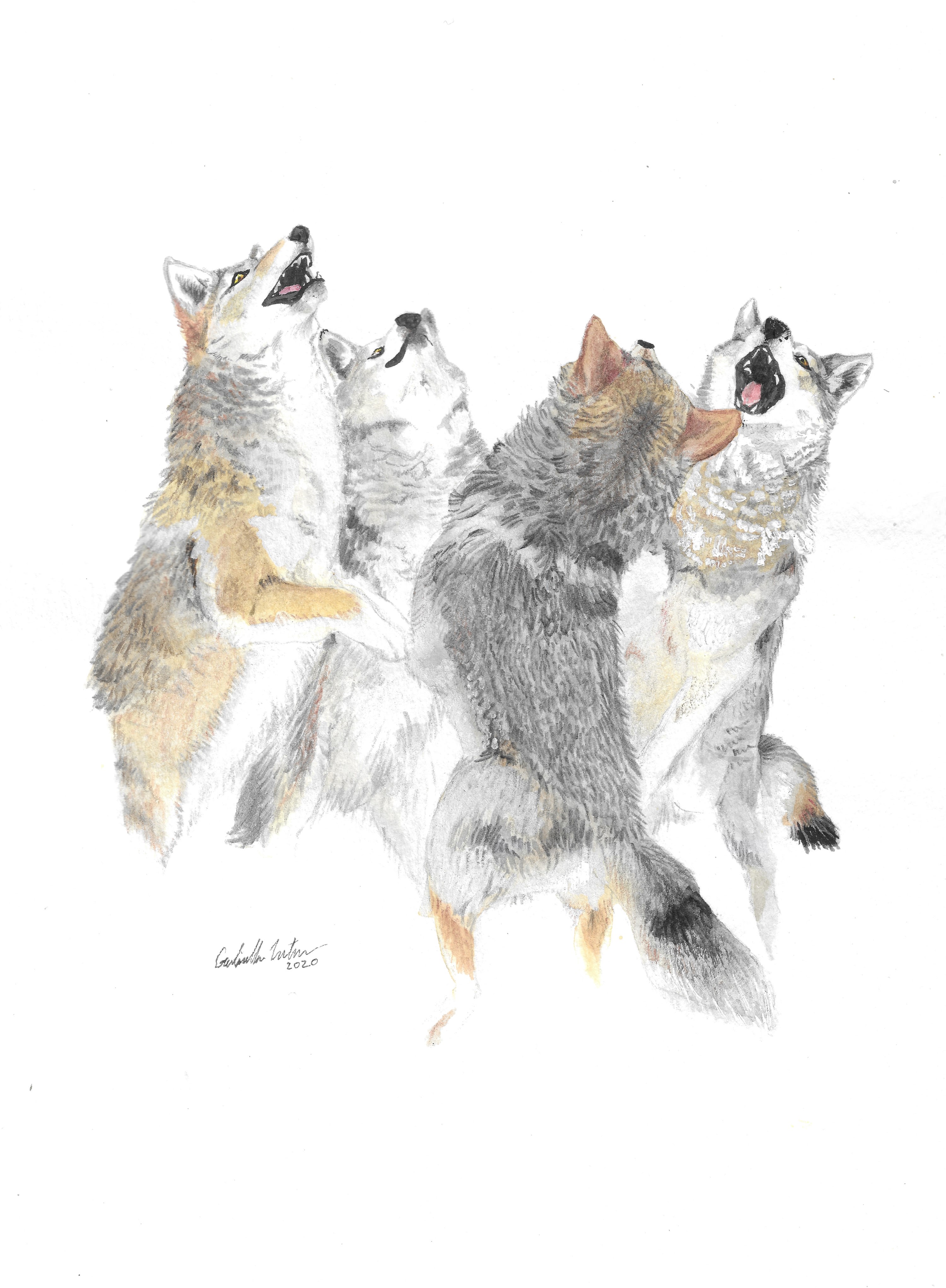
Title: Coyote Dance
Artist: Gabrielle Leiher
Medium: Mixed media (ink and watercolour on paper)
Reference image: Coyote Choir, photograph by Jim Cumming.
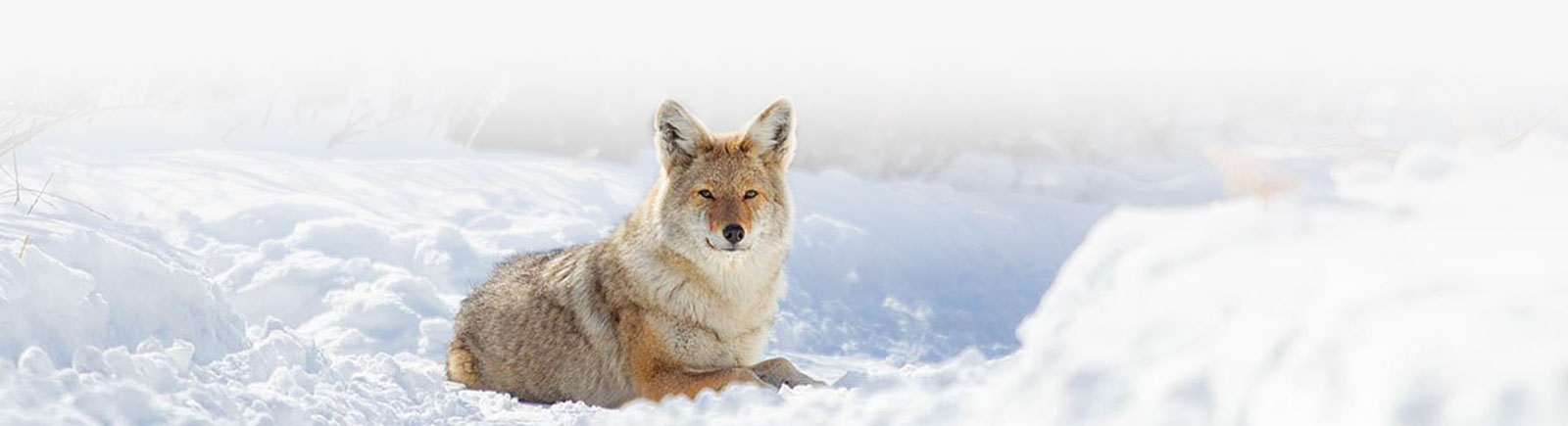
To celebrate National Coyote Day — March 23, 2026, we are honoured to feature works by artists Gabrielle Leiher, Wendy Brown, and narrative photographer James Beaton, whose creations blend artistic expression with nature literacy to deepen our understanding of coyotes. Coyote Dance by Gabrielle Leiher expresses the rhythm, spirit, and wild beauty of the coyote, while Wendy Brown’s Into the Light, inspired by the ethical photography of Ann, reflects the coyote’s resilience, family bonds, and role in healthy ecosystems. James Beaton’s From Winter Bonds to Spring Beginnings explores the seasonal rhythms of coyote life and how awareness of these stages helps guide respectful coexistence.
Together, these works invite us to replace fear with understanding and to renew our responsibility to live thoughtfully alongside the wild world we share.
Learn. Respect. Celebrate. Coexist.
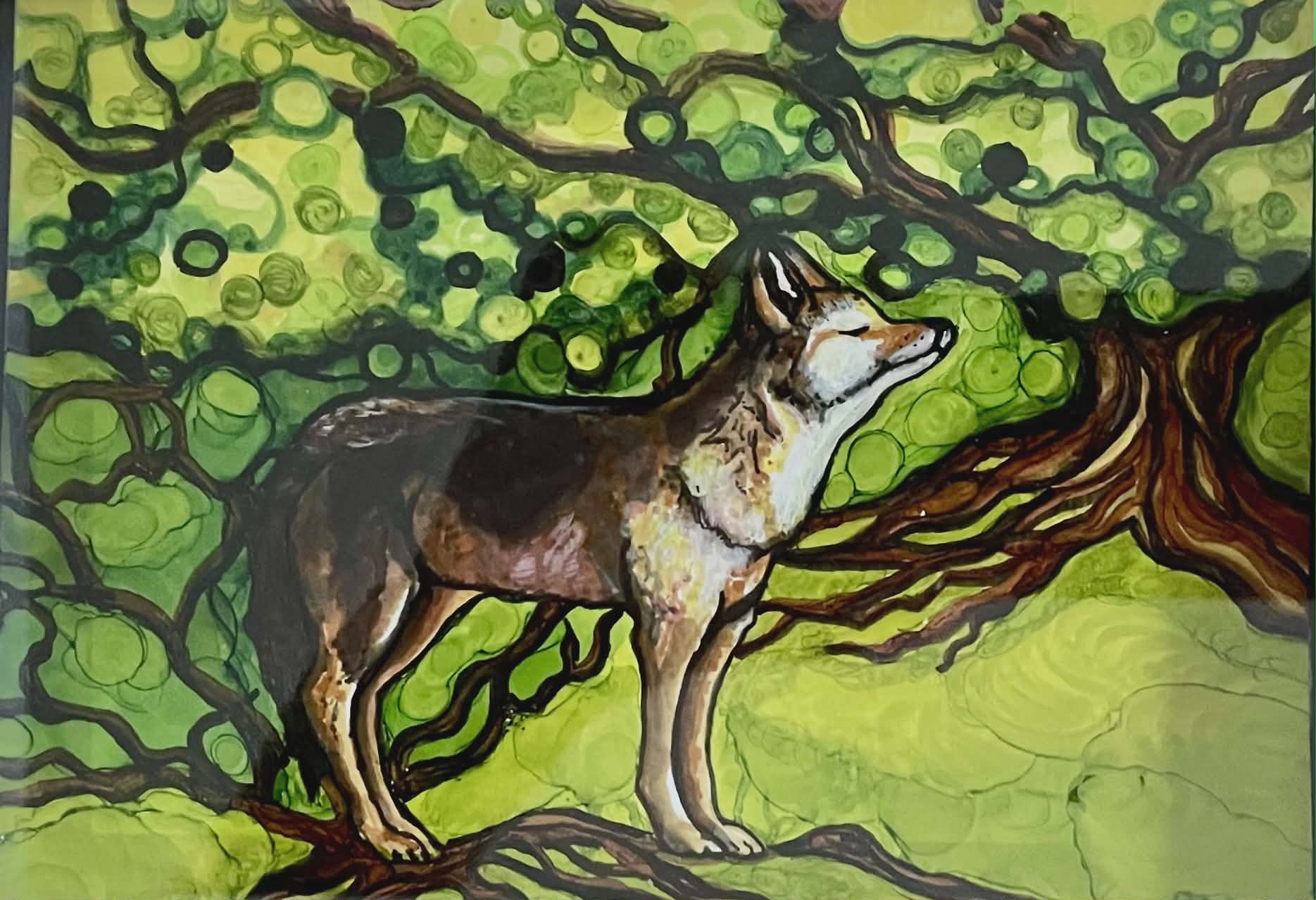
Title: Into the Light
Medium: Alcohol ink on Yupo paper
Inspired by the ethical wildlife photography of Ann.
Into the Light
by Wendy Brown
My illustration was inspired by a real moment in which a coyote steps into the sun to enjoy the very same pleasure we take; the pure joy of embracing sunlight on our faces. This piece illuminates and showcases something we share with them. It is a moment of connection and reflection. A moment not just in time, but in human history in which we can shed “light”, not only to recognize their sentience in that sunlit moment, but to share sound, science based canid ecology with one another, move from myth to celebration, and co flourish by bringing nature literacy to our lens.
My hope is for us to move out from under the shadow of outdated notions, and step into the light of their true nature and essential presence as residents, neighbours, and stewards of the rural and urban ecosystems we share with them. My chosen muse inspires for me, a reverence for wild lives, their sentience, inherent right to exist along side us, and for all that coyote families contribute. In loving reciprocity, may we step into the light with them and create a kinder, more inclusive relationship with wildlife such as coyotes, for them, with them, and in turn for ourselves.
Coyote’s presence shines through like rays of sun in dark cover of cloud opening us up to grasp our connection to all that is wild, sacred, and true.
Coyote’s ancient place beneath the stars lies in a genus whose vital role expands outward to every corner of the North American continent bringing balance, health, and new life to ecosystems everywhere. Coyote presence uncovers both the darkest of humanity and illuminates the brightest of lights. Coyote guides, teaches, and urges us to do better, to take up our responsibility to the Mother. Coyote trickster cleverly holds up our own reflection, calling out human bankruptcy of spirit with each degree of separation from the natural world.
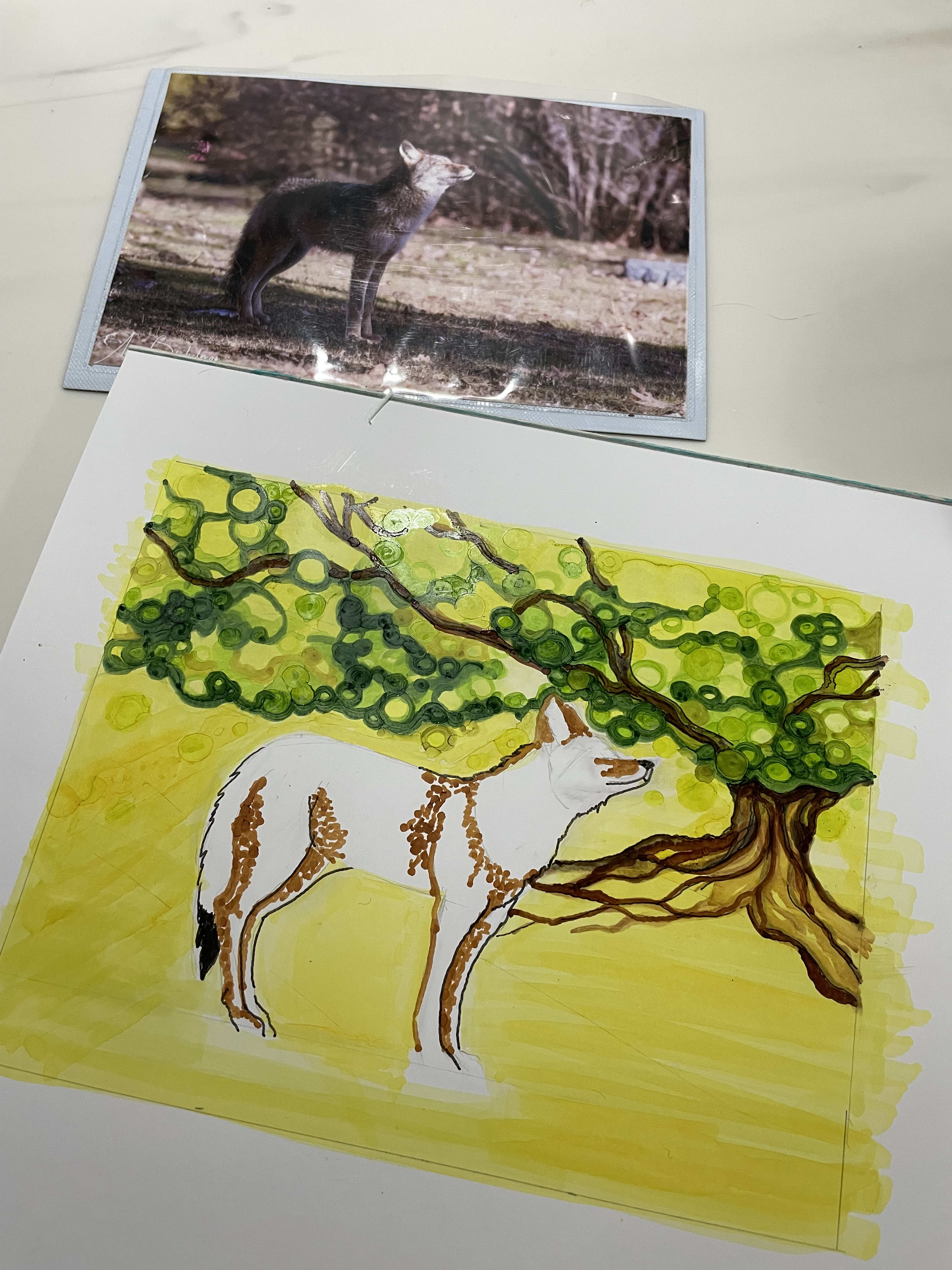
Deeply emotional, family oriented, and devoted lifelong partners, coyotes remind us that love above all else matters most. I am ever blessed by “shape shifters” in my life who work tirelessly to nurture that kind of love, kindness, and compassionate wildlife connection… You know who you are. I am ever blessed to take in coyote power to steady myself in this work, to walk in the wisdom of their footsteps, and to hear the sadness and jubilation of their song. (Photo below shows Wendy's creative process)
From Winter Bonds to Spring Beginnings
by James Beaton
In the coyote world, each season brings a new milestone. With the arrival of spring, I am thinking about the next big stage in their lives: raising their young. Soon they will be in their dens and eventually playful coyote pups will emerge to investigate the world. Knowing the stages can help us understand behaviour and take precautions so we can coexist while minimizing potential conflicts.
Across the year, their lives follow a general rhythm. Winter is the season for courtship and then procreating. Spring is the time for denning and rearing the pups. Throughout the summer, adults will teach their young to hunt and navigate the world with all its opportunities and risks. Then in autumn, the curious juveniles start exploring on their own, often remaining with their parents and siblings. Dispersal can happen at any point and is dependent on a number of factors, such as whether they are helping their family, whether they need to find their own territory, or whether they are seeking new beginnings elsewhere.
Coexistence strategies based on awareness are already being applied in some communities. For instance, the Town of Oakville is aware of a coyote den in a particular park and has temporarily closed the trail to reduce any potential issues that could arise if people or dogs intruded upon the den. This is a great example of taking precautions based on seasonal milestones. In summer, coyotes and their pups might be out of the den and moving through local green spaces while travelling together. Being aware of this can help avoid alarm if a family is together and visible in a park.
Juveniles venture out on their own expeditions in the late summer and fall. A young coyote’s behaviour may seem concerning for residents who do not know what is happening. For instance, sometimes members of the public will report a coyote “carefully” watching their dog, making them wonder if the coyote is looking for a meal. Think about it, though. In the fall, these coyotes are about 7–10 months old. They are going to be very explorative, as any puppy in the domestic world would. They likely don’t even know what a dog is. They may even approach to get a closer look. It is up to humans to teach them the boundaries, which they may not have learned yet. This is where aversion conditioning can be helpful.
These milestones can also be understood as general patterns, but not every coyote follows every one as if they are a strict set of rules. Each family is different, and factors such as available territory, food availability, and threats can shape how coyotes respond. For example, not every coyote mates. Many see a few coyotes and fear a strict multiplication, imagining each of those coyotes reproducing. Only one pair of coyotes within a territory will mate and have pups, so it is natural that populations will increase or decrease over time.
This is part of the brilliance of how coyotes can self-regulate their populations. Notably, some humans rely on outdated notions of “wildlife management” and engage in killing campaigns that disrupt coyotes’ self-regulation and can lead to increased conflicts, as coyotes have difficulty maintaining stable social structures. People can also be bad at estimating population numbers. Coyotes may be more visible in the fall and winter, making people think there are more of them than there are.
One troubling trend on social media is when seasonal milestones are weaponized against coyotes in the name of “education.” Behaviour is presented in exaggerated terms, leading people to think that coyotes are much more dangerous than they are.
In one social media post by a “nature” group, they warn about mating and denning season. The graphic is coloured mostly with red and black and features a coyote with glaring red eyes in a sinister landscape. The top text reads: “Coyote Danger: Highest Level” and “Escalating Threat,” as if it is a terrorism alert. The graphic then refers to mating and denning season with the warning that pets are in danger due to coyotes’ “extreme protective aggression.” This reliance on horror imagery and panic-inducing words can make anybody terrified if they don’t know much about coyotes.
Coexistence precautions should be applied year-round. It is not as if there is one season where it is okay to let your dog run through the woods unsupervised and another where it is not. A dog can encounter a coyote, or any other wild neighbour, during any season, whenever they are in parks and forests. People might think their dogs and cats are part of “nature,” but they are invasive to the ecosystem. In urban environments there is no natural circumstance where the population of canids would be so high. This is why it is so important for humans to be responsible by keeping both their pets trained and secured to ensure everyone’s safety.
Since pups are just around the corner, also be respectful and ethical around coyote dens. This includes giving the den a lot of space, limiting any visits, and not posting locations on social media or citizen science sites. If you discover a den in an area that has the potential for easy human intrusion (e.g., next to a busy trail or in a residential neighbourhood), it is always best to let local animal services know in case temporary steps can be taken to ensure everyone’s safety.
Through understanding, it is possible to appreciate coyotes for the intelligent, sentient, resourceful animals they are. As the flowers bloom and the grass turns green, we might see some coyote pups frolicking. Let’s do all we can to help them along.
This tribute is part of our ongoing commitment to nature literacy — learning how wildlife lives, how our actions affect them, and how coexistence grows through artistic expression, visual and written storytelling, knowledge, respect, and responsibility. Thank you for joining us in celebrating coyotes and the shared path toward compassionate coexistence. ~Coyote Watch Canada