
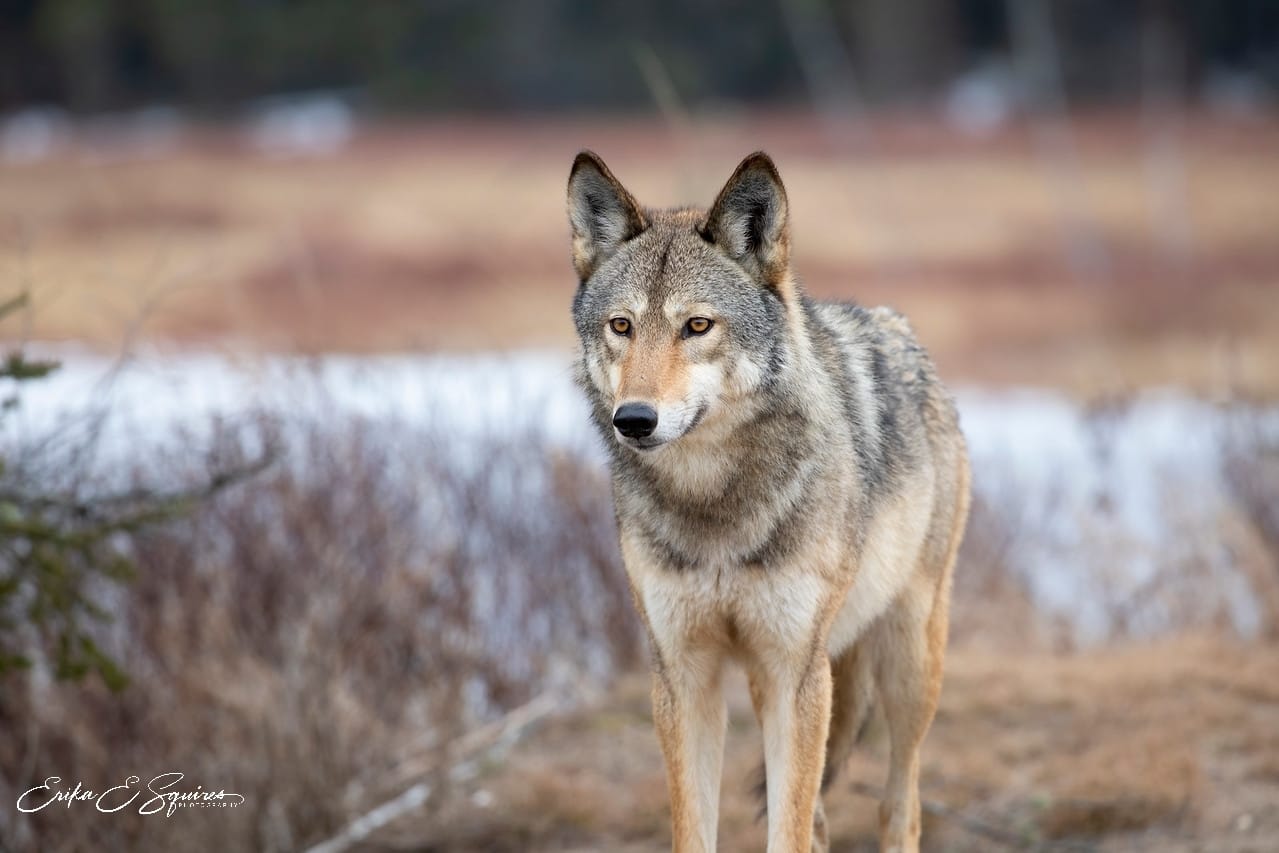
 Eastern wolf, formerly Algonquin (Canis lycaon | Canis lupus lycaon )
Photo by Erika Squires
Recent headlines claiming that a wolf “lured” an off-leash dog to its death in British Columbia have been widely shared, and understandably, they’ve sparked concern. Any loss of a companion animal is heartbreaking. But canid experts suggest the way this story is being framed warrants a closer look.
At the centre of the article there is a powerful claim: that wolves deliberately lure dogs. It’s a compelling idea but one that is often repeated without clear evidence. In this case, there is no direct observation or confirmed account showing that a wolf intentionally used deception to draw the dog away. Instead, the explanation appears to rely on a commonly cited but debated interpretation of canid behaviour.
It’s also worth considering that statements from the BC Conservation Officer Service may have been general in nature, intended to suggest possible behaviours, rather than provide a definitive account of what occurred in this specific incident. When presented without that context, such statements can be misinterpreted as definitive conclusions
Wildlife science paints a more grounded picture. Wolves are intelligent, yes, but their actions are typically driven by territorial instincts and defensive or predatory responses, not calculated schemes.
“In my experience, wolves don’t ‘lure’ prey. That’s not how they hunt”, shares Dr. Stephanie Rutherdord, an Associate Professor in the School of the Environment at Trent University, whose research explores the intersection of human-animal relations. “Wolves are cooperative hunters whose group dynamics and spatial positioning can influence prey movement during pursuit. Wolves may attack an off-leash dog as a canid trespasser on their territory, but luring suggests an intentional effort to trick another animal. It seems to me this kind of language works to ascribe human-like characteristics in ways that we should avoid if we truly want to understand wild animals.”
A critical piece of this conversation cannot be overlooked: the responsibility of keeping dogs leashed while recreating in wildlife habitat. When a dog runs toward wildlife - particularly apex predators like wolves – they are very likely perceived as a direct threat or intrusion. From the wolf’s perspective, a fast-approaching dog can resemble a competing canid or a danger to their pack or territory, triggering an immediate defensive reaction.
This is not unusual behaviour - it is predictable. And it is preventable.
That missing context matters. The article notes the dog was off-leash but understates how crucial that factor is. Across North America, wildlife experts consistently warn that off-leash dogs are at much higher risk in wolf habitat. They can roam out of sight, approach wildlife, and escalate encounters that might otherwise be avoided entirely.
“Although there are occasions when a wolf will kill another wolf, or coyote, or dog considered to be a threat, wolves have evolved several ways to communicate in effort to help unknown canids avoid each other – leaving behind scent and visual cues, and vocalizing in their surroundings as a notice that the area is being occupied”, describes canid expert Sadie Parr, adding, “but dogs often do not obey these signals, or have lost the ability to interpret their meaning. And we should not expect them to. It is the responsibility of people to keep dogs on leash for their safety and for the well-being of sensitive plants and wild animals, as well as for other people and leashed dogs that may not want uninvited company”.
Leashing dogs is not simply a suggestion; it is a fundamental responsibility when sharing space with wildlife. It protects pets from harm, reduces stress and risk for wild animals, and helps prevent exactly these kinds of tragic outcomes.
There’s also a broader issue with how stories like this are told. Repeating the idea that wolves “lure” pets can unintentionally reinforce fear-based narratives, portraying wildlife as deceptive or malicious. That framing doesn’t just oversimplify complex animal behaviour; it can also undermine public support for coexistence and conservation.
Sadie Parr believes strongly that the language to describe these interactions matters, explaining, “misuse of language that describes motives and behaviour allows us to incorrectly place our own ideas, often of deviance, onto non-human animals to describe things that don’t really exist. This is an inherited false bias that needs to be replaced with knowledge, empathy, and responsible reporting”.
None of this is to dismiss the seriousness of the incident. Rather, it serves as an important reminder that we share space with wildlife, and that responsibility requires risk awareness. Keeping dogs leashed, staying alert, and respecting habitat boundaries aren’t mere recommendations; they are essential practices that protect pets, people, and wildlife alike.
If there’s one takeaway, it’s this: we don’t need myths to understand what happened, only a clear understanding of animal behaviour and our responsibility within shared landscapes.
5 Quick Safety Tips for Coexisting with Wildlife:
1. Keep dogs leashed - always
Your leash is your best tool for preventing dangerous encounters, as it prevents your dog from chasing or approaching wildlife.
2. Stay aware of your surroundings
Watch for tracks, scat, and signs of wildlife activity especially in areas known to be their habitats.
3. Don’t let pets run ahead
A dog out of sight is a dog at risk. Keep them close and under control.
4. Carry deterrents and know how to use them
Tools like bear spray (where legal) can be effective but only if you’re prepared.
5. Respect wildlife’s space
If you see wild animals, give them ample distance and never approach. It reduces stress and risk for everyone.
This blog was co-authored by Coyote Watch Canada and The Fur-Bearers as part of our shared efforts to promote informed, compassionate wildlife coexistence. Special thanks to the canine experts whose knowledge and expertise contributed to this piece and to. Much gratitude for the ethical photo features.
Stephanie Rutherford is an Associate Professor in the Trent School of the Environment and award-winning author of Villain, Vermin, Icon, Kin: Wolves and the Making of Canada.
Sadie Parr is the founder of WeHowl.ca, a collective working to end government‑sanctioned wolf and coyote kill programs and transition to evidence‑based, ethical, and ecologically sound policies and practices. Sadie also serves on the Science Advisory Board for Coyote Watch Canada.
Erika Squires is a passionate, ethical wildlife photographer, who cares deeply for her subjects. She has lent many images to different conservation and educational groups to help protect wildlife.