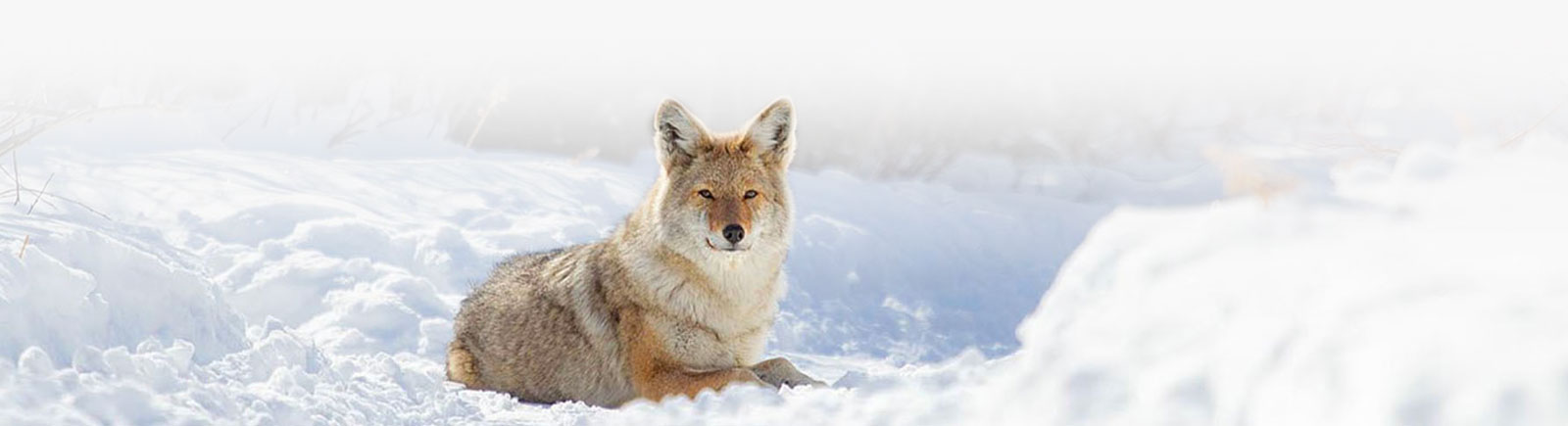
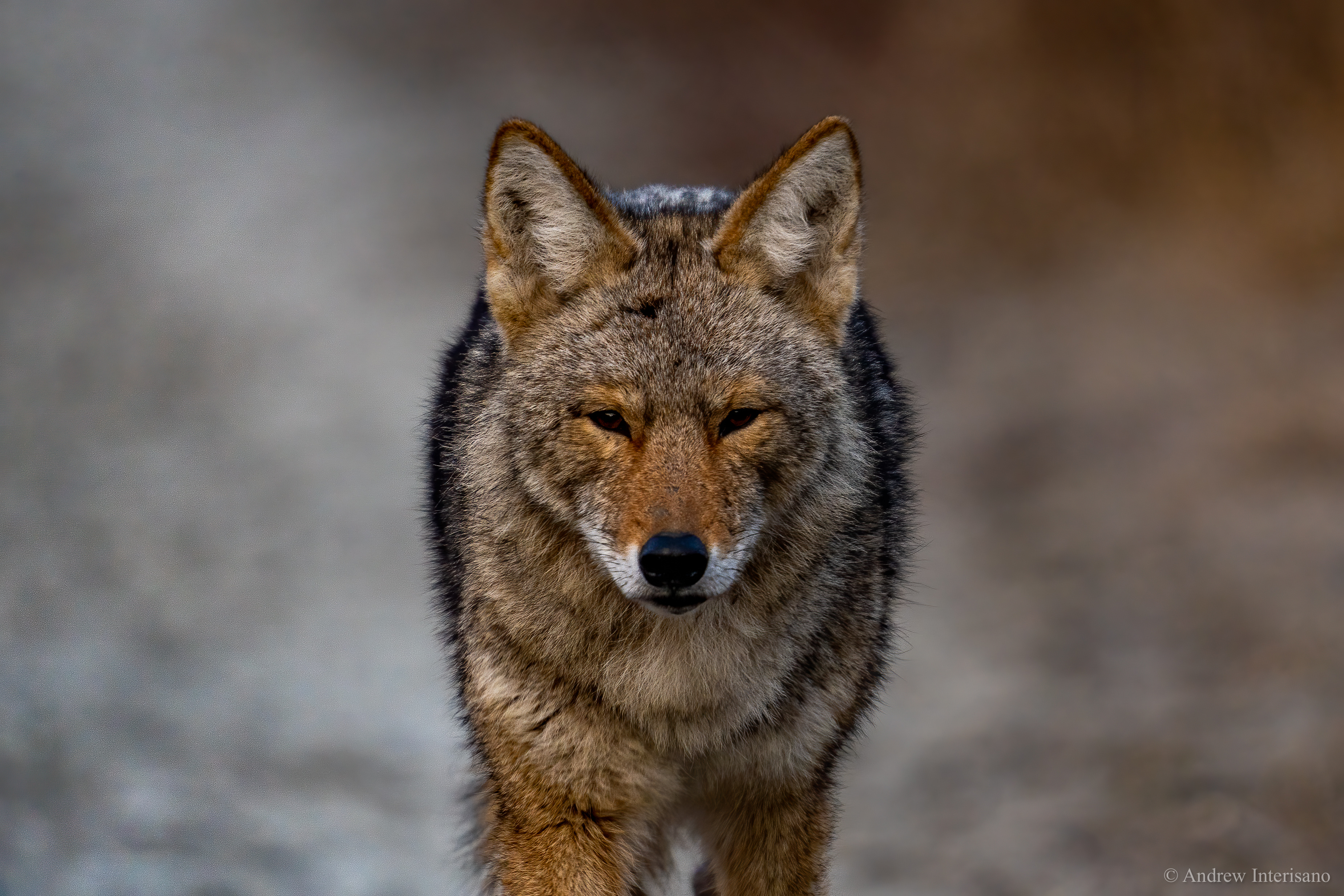
There are photographs that document a moment and then there are photographs that invite us into another being’s world.
For wildlife photographer Andrew Interisano, photography is about far more than capturing an extraordinary image. It is about connection: slowing down, observing, respecting boundaries and allowing wild animals to simply be wild.
Coyote Watch Canada is delighted to welcome Andrew as an upcoming guest in our Canid Connections Speaker Series, where we will explore his journey into nature photography, his special affinity for wild canids and the experiences behind the images that have earned recognition for his work.
Andrew’s relationship with Coyote Watch Canada also carries a particularly meaningful connection.
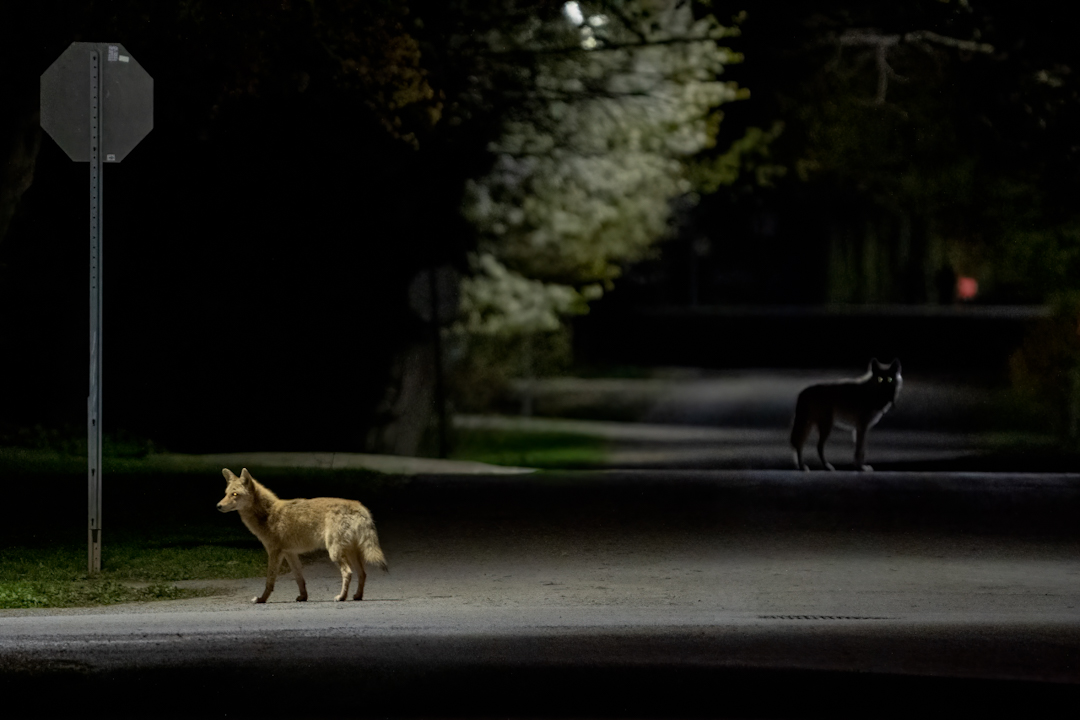
Following the recognition of one of his remarkable wildlife photographs among the Top 100 in Wildlife Photographer of the Year, Andrew generously chose Coyote Watch Canada to receive a portion of the proceeds from the sale of the beautifully framed special-edition photograph. The exquisite photo that landed his international popularity is shown below titled Midnight Ramblers.
For us, that generosity represents something much larger than a donation. It reflects the powerful intersection between art, ethical wildlife photography, conservation and compassionate coexistence.
Ahead of his Canid Connections talk, we invited Andrew to share more about the person behind the camera, the experiences that have shaped his work and why wild canids continue to hold such an important place in his heart.
In Conversation with Andrew Interisano
Q: Andrew, let’s begin with the person behind the camera. Where did your journey into nature and wildlife photography begin? Was there a particular experience, place or animal that first inspired you to pick up a camera and begin documenting the natural world?
A: I feel like there are many links in the chain within my journey. I was fortunate enough to grow up in a town with access to wetlands, rivers and trails, so I was around nature from a very young age. Additionally, trips to the Toronto Zoo, childhood books full of animals and TV shows like Kratt's Creatures gave me a real sense of wonder about the natural world. Then I could go outside and see in person what I'd been looking at on TV and in those books, and that really sparked something in me. It was the beginning of my curiosity, and my love and respect for nature.
Somewhere along the way to becoming an adult, I lost touch with that. I bought my first camera in 2018, but I didn't have wildlife in mind at the time, and I don't know if or why I was reluctant to put the two together. Eventually though, my eye naturally started gravitating back to my first love, and I began to feel all the same wonder I had as a kid, and more.
Q: You clearly have a deep connection with nature. Where does that connection come from, and what happens for you personally when you spend time immersed in wild spaces? Has photography deepened that relationship over the years?
A: It certainly has. When I capture a subject, and particularly if it’s a shot I really love, they become a bit of an obsession for me. I always want to know as much as possible about a particular species, group or ecosystem.
Nature really is our best teacher, and I love digging into things like behaviour, ecology, and really anything that can help me get a better understanding about our world. Interestingly though, chasing the “next great shot” has been somewhat overwhelming and certainly a humbling experience, so lately I do find myself leaving the camera behind and just trying to observe and enjoy.
Q: Wild canids hold a special place in your photography and your heart. What is it about coyotes, wolves and foxes that draws you to them? What have you learned from simply watching and spending time in their world?
A: Mostly that they're far more relatable than people assume. Coyotes are family-oriented, curious and even playful from my observations, and they're about the closest thing to a dog that exists in the wild.
But that closeness cuts both ways. Because they look and act so much like our dogs, we project dog traits onto them. We assume they think and feel the way our pets do, or we weave human motives into what they do. They're wild, protective of their family and territory, and driven by survival.
The similarities are what draw us in, but we need to hold them alongside the differences, because ignoring either one leads us to misread the animal.
Q: Some of the most powerful wildlife photographs come from patience rather than pursuit. What does ethical wildlife photography mean to you?
A: It means a great deal. I have a deep reverence for nature, and I put the animals' well-being above getting the shot. Have I made mistakes throughout my journey? Absolutely. But I’m always striving to be better each time I go out.
And what that means is anything from studying the behaviour of animals, to equipping yourself with the right training and tools to have the least amount of impact. There are all sorts of ways you can lessen your impact, while still setting yourself up for an incredible shot.
Q: How important are distance, restraint and respecting an animal’s boundaries when creating an image?
A: I think in my early days, I had this “one with nature” type notion that to love animals was to be close to them, but as I’ve matured I’ve realized it’s actually the opposite.
As I’ve grown I’ve realized to love animals is to let that notion go and allow them their space. I’ve personally found as well that the more space you provide, you often come away with much more fascinating photos when they’re in their natural unbothered state.
Q: One of your photographs received remarkable recognition, being Highly Commended among the Top 100 in Wildlife Photographer of the Year. What is the story behind that photograph? Can you take us back to that moment—what you witnessed, what you felt and what the recognition meant to you as a photographer?
A: In the spring of 2021, I was out every other night for about 2 weeks trying to photograph the skunks in my neighbourhood in Niagara-on-the-Lake.
One night between 10 and midnight, something cut across the road ahead of me. I didn't recognize what it was at first, but when I turned the corner there were two coyotes standing in the middle of the road. I immediately pulled over, poked my camera out the window, and began photographing.
Once the adrenaline wore off, I realized why they'd stopped. Another group was howling somewhere nearby, and they were listening in. I suddenly had this feeling to put the camera down and just take in the magic of the moment. We had that moment together, and then they were off.
The award means so much to me. To have one of my photos make it to that level, and to rub shoulders with some of my wildlife photographer and conservation heroes… let’s just say I’m still pinching myself.
It was such a brief moment in my photography journey, and there was a ton of chance in being able to capture an encounter and composition like this, but for me it represents all of the hard work and preparation I put in leading up to that moment to allow for those conditions to present itself.
Q: You made the incredibly generous decision to direct proceeds from the sale of the beautifully framed photograph to Coyote Watch Canada. Why did you choose CWC? Was there something in our work, our approach to coexistence or our advocacy for wild canids that particularly resonated with you?
A: I think there are two main things, one is the Municipal Framework the CWC has created. It’s such a thoughtful program grounded in community and I’m just so in awe of the work and the approach.
The second is the dedication the CWC team has in the field. You’re truly heroes in my mind, doing the hard, literally “boots on the ground,” work for the benefit of these animals and our communities.
Wildlife photography takes a ton of patience and dedication, and I hope that my work can have a positive impact in some way, but it pales in comparison to what I see CWC doing and that’s why I chose to support and just try to contribute where I see the material work being done.
Q: Wildlife photographers have a unique opportunity to introduce people to animals they may never encounter themselves—and sometimes to species that are misunderstood or unfairly portrayed. How do you see photography contributing to education, advocacy and changing those narratives? Can an image help people move from fear or misunderstanding toward curiosity, respect and empathy?
A: I believe that storytelling is one of the most powerful tools we have in moving people into action, and photography is one of our great storytelling mediums.
I do try and focus a lot on the storytelling aspect in hopes that it can spark curiosity in others. I often find that the most powerful photographs have the ability to tell a story all on their own, but those are also the most difficult to capture in a single scene.
It’s why I put so much emphasis on my writing alongside my work because it often can carry an image and its cause much farther in terms of impact.
They say a picture says a thousand words, but sometimes you need 1,200!
Q: As you prepare to join us for Coyote Watch Canada’s Canid Connections Speaker Series, what do you hope people will take away from your photographs and your stories?
A: I hope I can inspire others to chase their passions, even if it’s in a small way. Some people get lucky and their passion becomes their career. That wasn’t me unfortunately, but I had this realization that if I really wanted something then I would figure out a way to do it.
It might not work out the way you initially envisioned it, but the journey alone is the reward.
Q: And if you could leave people with one message about wild canids and our responsibility to respectfully share the landscape with them, what would it be?
A: I hope people will simply walk away with the power of curiosity. Whether the issue is coyote coexistence or something else entirely, I hope we choose curiosity over fear. Be curious about why a coyote is behaving a certain way and what the root cause might be. Be curious about how a concerned neighbour is feeling, and what's behind it.
Curiosity opens the door to empathy, and empathy helps us understand each other. From there we can come up with stronger solutions that work for everyone, people and wildlife alike. At its best, wildlife photography asks us not simply to look at an animal, but to see them differently. Andrew’s work offers that invitation. To observe. To wonder. To respect.
And perhaps, through a single photograph, to recognize that the wild beings with whom we share this world have stories of their own.
Coming Soon Saturday, December 5th @2pm ET: Choose Curiosity: A Conversation with Wildlife Photographer Andrew Interisano
We look forward to welcoming Andrew to the Coyote Watch Canada Canid Connections Speaker Series December 5th @2pm ET and sharing more of his extraordinary photographs, experiences from the field and reflections on the wild lives unfolding on the other side of his lens. Registration is required here.