
How does the dismantling of Ontario’s endangered species legislation impact wolves and coyotes?
Recently, Ontario made some glaring changes to species at risk legislation, wiping out the once-lauded Endangered Species Act and replacing it with a watered-down and largely toothless Species Conservation Act. These changes have the potential to undermine what little protections exist here for both coyotes and wolves.
To understand this, let’s backtrack a little and get some context about these animals.
Ontario is fairly unique in that it is home to 3 large canid species: grey wolves in the north and far north, eastern wolves in a few pockets of central Ontario, and eastern coyotes pretty much everywhere else, especially in the south. These locations are not clearcut, and they do overlap in central Ontario.
These canids exist on a spectrum that is more than geographical, too. Grey wolves are the largest, eastern wolves are intermediate, and eastern coyotes are the smallest.
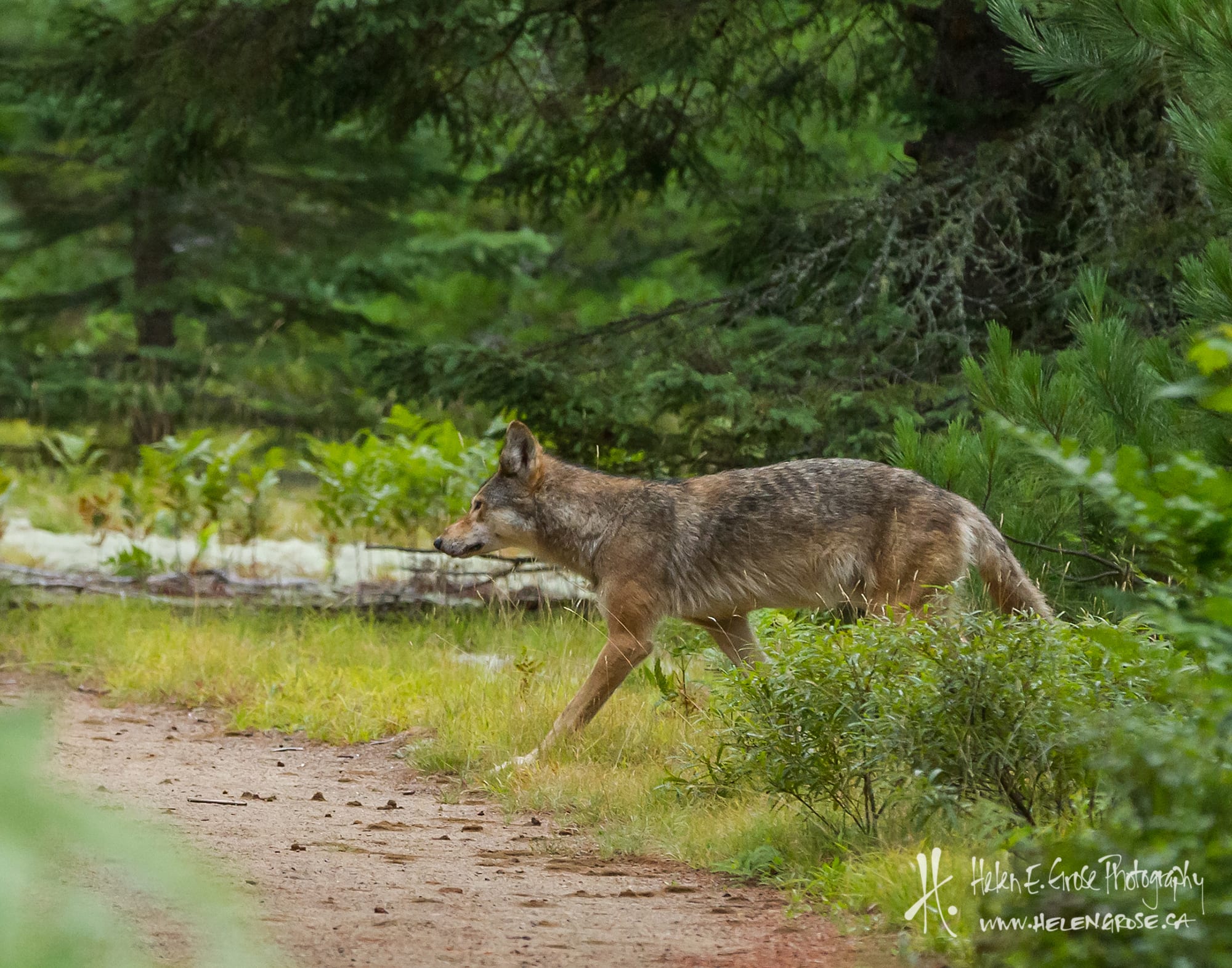
Eastern wolves’ intermediate size and placement between grey wolves and eastern coyotes makes them an ecological and genetic bridge that links all three species together. This is so much the case that hybridization between grey wolves and eastern wolves, as well as eastern wolves and eastern coyotes, has led to a veritable mixture of animals that are largely impossible to place on the wolf-to-coyote spectrum without genetic testing. If you showed me a picture of a large canid like the photo below from central Ontario, I’d have a very hard time telling you whether it’s an eastern wolf or not. I can make an educated guess, but it likely has genetic signatures from all three species.
Why does this undifferentiated mixture matter? Well, for starters, eastern wolves are very rare, and are at risk of extinction. These are the only canids in Ontario who are afforded some legal protection because of their risk status (Threatened). Grey wolves and eastern coyotes are abundant enough that they are not considered at-risk and are generally “managed” in Ontario, which means the province prioritizes their non-sensical killing by hunters and trappers who believe that these animals need to be controlled by humans or believe they should be dead.
The mixture of canid species in Ontario (and Quebec, which is the only other place where all three species are found) has also “complicated” the story of eastern wolf recovery.
Wolves, coyotes and the Islands of Protection
In 2016, when eastern wolves were listed as Threatened under Ontario’s old Endangered Species Act, they were supposed to be protected from being killed, harmed and harassed, or having their habitat destroyed across the province.
To meet that legal obligation for eastern wolves, hunting of all wolves and coyotes would have to be banned, since you need DNA to tell them apart, and hunters and trappers don’t have the ability to differentiate in order to avoid killing the one at-risk species. That ban would have needed to be in place throughout the known extent of occurrence of eastern wolves, which is stretched out across central Ontario and western Quebec.
Perhaps not surprisingly, there was insufficient political will to make that necessary change in order to adequately protect eastern wolves from their primary threat: human-cause mortality, and send them down the road to recovery. But humans are deeply controversial animals still, thanks in large part to European folklore imported into North America, biblical ideas held over into modern times, governmental failures to equip livestock farmers with tools to coexist with large carnivores more generally, and the media’s ongoing struggle to portray wolves for what they truly are, rather than what we think they are based on these old fears. If wolves have it bad because of this reputation, coyotes have it much, much worse. Eastern coyotes are still treated and destroyed mercilessly in most areas of North America, including Ontario. Many people believe they have no use at all. If you’re reading this blog, you likely suspect or know this to be false. All animals have inherent value as fellow members on our planet, and eastern coyotes certainly have plenty of ecological value, as well.
Unfortunately, this reality is not understood by decision-makers in our province. To avoid protecting the under-appreciated coyote, Ontario opted out of the automatic province-wide protection of eastern wolves and instead limited the no-killing zone to a few provincial parks and buffer zones around parks where previously completed genetic surveys had confirmed the presence of this rare wolf species. It’s easiest to think about this decision as the Islands of Protection. In those areas, it is illegal to kill eastern wolves as well as other large canids. But these areas are too small to matter much in the long-run, and canids don’t understand or abide by human-made maps and the arbitrary protection those maps determine.
Elsewhere, canids are metaphorically at sea. The province kept regulations in place that allow hunters and trappers to kill whichever large canid species they came across; at-risk eastern wolf, or not. This is still true today. Killing is particularly unregulated in southern Ontario, where the season is always open, there is no maximum number of canids that can be killed, and reporting is scant or non-existent.
Ten years have passed. Many hundreds of large canids have been killed in Ontario in that time. Eastern wolves have not recovered, and the province’s own research suggests this current situation will not support eastern wolf recovery.
Doug Ford’s environmental rollbacks
The Progressive Conservatives in Ontario came into power a couple of years after Ontario legally abandoned eastern wolves the first time. They quickly abandoned the finalization of the legally-mandated provincial Recovery Strategy, a document written by third-party scientists to provide the province with recommendations to achieve eastern wolves’ recovery. They claimed the delay was needed because the situation was overly complicated. What they meant was, they didn’t want to protect eastern coyotes and grey wolves for eastern wolves’ sake. In Ontario, eastern coyotes simply do not matter.
Over the past years, I personally hoped we would collectively vote the conservatives out and usher in a new era in which we could reorient toward protecting and recovering our rare wolf species. We didn’t. And now, in furtherance of the extensive and alarming rollback of environmental protections and diligence in Ontario, Ford once again ripped out the proverbial rug from species at risk by destroying what little was left of our Endangered Species Act before replacing it wholesale with the Species Conservation Act (SCA).
The main point of this enormous legislative change was to increase development in species at risk habitat. Broadly speaking, people who want to destroy this habitat merely have to register that destruction, and don’t need to get permits or otherwise protect or offset habitat to make up for that destruction.
The SCA provides few baseline protections for species at risk, but to date, there have been no changes to regulations that affects eastern wolves or their coyote and grey wolf neighbours. Unlike many other species, the wolf remains legally listed and the regulations that protect it in and around some provincial parks still exists.
The Mysterious Case of the Eastern Wolf Recovery Strategy
The islands of Protection were posited as an interim approach while we waited for the final Recovery Strategy to better guide us toward protection measures that would lead to the species’ recovery. However, the SCA also scrapped the idea of recovery planning documents, which erased the need for the eastern wolf Recovery Strategy to ever be completed, published, responded to by the government, or checked on in 5 years time to assess their progress. All of those steps were once mandated by the old ESA.
Oddly, after proposing to swap out the ESA for the SCA, Ontario rather suddenly reinvigorated their effort to pay for the completion of the eastern wolf Recovery Strategy that had been collecting dust since 2018.
That Recovery Strategy is now far closer to being complete, but Ontario has internal communications indicating that they have no intention to publish it now that they are no longer legally obliged to, let alone follow any recommendations therein.
Who else is responsible for eastern wolf recovery?
The federal government has been lately making moves to open up development, and override environmental protection for habitat themselves. None of this bodes well for eastern wolves.
Canada has its own federal species at risk legislation called SARA — the Species At Risk Act. Like Ontario’s old ESA, it requires scientific risk assessments for species, and legal listing of species found to be at-risk. Eastern wolves are Threatened under SARA the way they are in Ontario. As such, they will get their own federal Recovery Strategy, which is likely being finalized this year. While that Strategy doesn’t provide protections for species at risk on provincial or private land, which makes up the majority of eastern wolf range, it will make recommendations that would be applicable to Ontario more broadly. The Ontarian and Canadian Recovery Strategies should theoretically have much in common. Indeed, they are being written by the same scientific consultants.
Wolf Awareness is currently working on a project that will hopefully engender a solution for wolves (and eastern coyotes, grey wolves and admixed animals) that sticks. You can take action for eastern wolves here, in the meantime, and call on Ontario to follow the proposed canid protection that dates way back to 2018!